Showing posts with label sound archives. Show all posts

Wednesday, April 16, 2014

The Kalahari Desert Festival 21 - 23 March 2014 > "Sound Hunting" for archival purposes

SOUND HUNTING 
by Moshe Maghundu
Archivist: SABC Platfontein 

The Kalahari Desert Festival took place for a second time in the Kalahari at Andriesvale, ten kilometres from Ashkam. This event is very historical in nature to the SAN people as it brings together all San people from different countries with their traditional festivities.


The San people from Platfontein, the Kalahari, Upington and others from the Western Cape took part as the festivities started on the evening of Friday, 21 March, on Human Rights Day.

Moshe Maghundu was there with a crew to do “sound hunting”. He was able to host storytelling sessions with the Kalahari people and others. The people gave their full cooperation. He faced challenges with some people expecting to be reimbursed for their oral contributions. He complied out of his own pocket because of his love for the project. He understands and put a great value on their contributions for heritage and archival purposes.

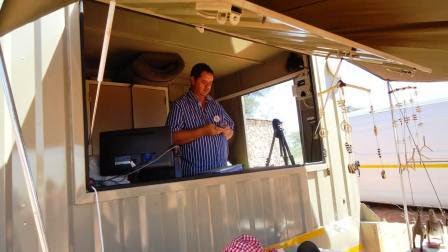
Station X-K FM covered the event live from its opening till the evening of the last day Saturday 22 March.They were also responsible for arranging some of the interviews which Moshe recorded.

Mr Markus Jetembo        Presenter
Mr Joe Mpungo               Presenter
Mr Piorro Mushavanga   Producer
Me Rena Maghundu       Technical Producer
Mr Moshe Maghundu     Archivist

X-K FM
X-K FM struggled with some technical difficulties, but luckily the technical producer took care of the problems.


It is highly appreciated that Mike Nemane provided the gazebo in which the broadcast took place.

The challenges of the Kalahari sand did not put a damper on the uplifting spirit of the festival.
Moshe Maghundu was working non-stop to get the people to tell their stories. Although it was hot, time was limited for him to get all the interviews.

Moshe Maghundu during a short break
before taking up the Marantz recorder again
DRAPJJ STARS
There were music performances in the main tent. The group from Platfontein, called the DRAPJJ STARS, with hip hop and rap music, mixed it up with the San language and the English language.

DRAPJJ STARS
The moment DRAPJJ STARS stepped  on the stage, every one in the surrounding areas ran to the tent to watch their performance.

X-K FM presenter interviewing young people
On the evening of the last day the presenter interviewed  young people about their  experiences at the Kalahari Desert Festival 2014. The presenters did an excellent job.


The donkey carts were the only transport allowed at the venue. People had to pay to be transported around in the area and it was found to be very trustworthy.

Hennie Swart
Special thanks goes to the main man, a friend, organiser and everything of the Kalahari Desert Festival.
He started the initiative for the San people to share their cultural heritage. His name is Hennie Swart, the only white man with a black surname. He drives a black Isuzu truck and likes wearing his black t-shirt.

Also thanks to the following people for making the trip a success:

Me Regina Beregho, X-K FM station manager.
Mr William Heath, Line Manager RBF.

Tuesday, October 9, 2012

The new archivist interview: Sound Restoration

Obakeng Phiri
Archivist: Sound Restoration
SABC Radio Archives


Obakeng Phiri is a new archivist tasked with sound restoration in the SABC Radio Archives.
He has been an intern with us for a couple of months, and he started to work here on the 1st of August 2012.

The previous interview with Obakeng was about his internship at the SABC Radio Archives.

His duties are different now than before when he was an intern here.

Obakeng, please tell us about a normal day in your studio.

I am self motivated because I am very passionate about being an audio restoration archivist. 
Every snippet of audio content I work with contains interesting information. It adds to my anticipation of looking forward doing my job each day!

My job involves the separation of sound from the format it was recorded on. It also involves the “cleaning” of sound, getting rid of clicks, pops, scratches and hiss that often plague the original recordings. 
In some instances, the desired sound is so close in character to the noise, that the noise cannot be cleaned so as not to sacrifice parts of the sound that we want to keep. 

The workflow is not complicated, but it must be performed carefully to achieve the best results. 

Every experience in the studio is a learning curve. I learn different subjects from history, politics as well as listening to radio dramas. 
Depending on the mood I am in, every hour is spent on a different subject.  

Tell us more about your collection and the scope of material you need to preserve.

I work with most of SABC’s radio broadcast material, which includes radio dramas, radio features, actuality and many more. One example is a feature programme on Bertha Solomon, pioneer of women’s rights in South Africa.

Do you have an anecdote about an interesting piece of audio material that you have encountered?

The following is in our collection: ‘’I am an African’’ speech by Thabo Mbeki.
It introduces his vision on the African Renaissance, which is about empowering Africa economically and socially.

Why did you want to work here again after you have completed your internship here?

When I first came here for the first time as an intern, I already knew that I wanted to work at the SABC Radio Archives. It felt like I was home! Due to my passion for the job, I was given the chance to prove myself. It paid off in the end!
I am very grateful for it, praise God!

Related posts:

- Interview with an intern at the SABC Radio Archives: Obakeng Phiri

- The value of internship in the SABC Radio Archives


Questions and blog post by Karen du Toit, Afrikaans Archivist in the SABC Radio Archives.

Tuesday, October 4, 2011

Last day of an archivist on the job - Markus Mmutlana (Vlog1)

Markus Mmutlana, our News and Actuality Archivist in the SABC Radio Archives, went on retirement last week.

He describes how he came to realize the importance of archives after he started working as an archivist in the Sound Archives.

See a previous interview with him about his daily work as an archivist:
The Weekly Archivist interview: News and Actuality archivist

It is sad to see a lifetime of acquired knowledge walk out of the archives. Markus has a wealth of experience and information in the Broadcasting Industry as well as the history of South Africa through his work as a news and actuality archivist. He was unable to carry some of that tacit knowledge over to a new successor because posts have been frozen. It was not possible for him to teach his successor while he was still working here.

May you enjoy your retirement, Markus!


This is an experimental Vlog by Karen du Toit, Afrikaans Archivist in the SABC Radio Archives.
(Apologies for  the less-than-perfect quality as it was recorded on a cellphone.)


Friday, September 16, 2011

The daily challenges of a sound archivist

Each job has its own intrinsic frustrations that comes as a given. The sound archivist in a broadcasting environment also has a fare share of daily frustrations. I will call it daily challenges.

Daily challenges of a sound archivist

  • Having to unlock a sound carrier without any information. There is no extra data on the cover, or inside. There is no information on the sound carrier itself. 

The cover of a reel-to-reel-tape (no indication of what is inside)

Inside: a reel-to-reel tape with a cryptic note: "Patrick Mynhardt reads  Herman Charles Bosman" Tape 1
But the sound differs from the note...

  • The sound carriers are degrading, and some we can't recover. The mini-disc carriers are some of the fastest degrading carriers, and we are unable to digitize it as it degrades.
mini-disc carrier
  • The sound recording and sound playback devices are going obsolete, and we are unable to get it serviced properly as well as get parts for broken items.
Reel-to-reel-tape Studer tape recorder
CD, MD and tape cassette machines stacked on top of each other
  • The journalists, programme producers and programme managers do not alert us to new programmes or special broadcasts or a change in the daily schedule. (Although we have asked to be kept in the loop.)
  • The journalists, programme producers and programme managers do not attach meta data or information about a programme on the sound being made available or on broadcast.
  • The public and journalists / producers expect us to be on top of a 24/7 broadcast feed, and to have it catalogued as well! It is impossible!
  • The digital world brings it own challenges. It is wonderful to have the audio available on the computer, but it does not help at all when the meta data was not added correctly. It is sometimes even more trickier to find out the origins of a piece of audio when it is only marked with temporary titles.
Dalet 5.1 Digital Audio System
  • Going to the shelve, and finding it empty. It has been removed for request purposes (hopefully) or else it means that it is lost. 
  • The request archivists deal with journalists who runs in at the last moment, and expect to find a sound clip to use asap. 
It is only some of the challenges that we face on a daily basis in the SABC Radio Archives. 
Can you add to this list?

Post by Karen du Toit, Afrikaans Archivist in the SABC Radio Archives.

Friday, July 1, 2011

The Weekly Archivist interview: English Archivist

Phindile Maringa
The SABC Radio Archives has Archivists who focus specifically on a specific radio station and/or an indigenous language. This is the last interview as part of a series of interviews where they answer the same questions addressed to them.

It is a way of getting a better understanding of what an Archivist do, as well as getting a better insight into the scope of our collections.

The Archivist answering the questions this week is Phindile Maringa. She is the archivist for SAFM. She has been with the Radio Archives for nearly 3 years.

Phindile, please tell us a little bit about yourself. (Where you grew up, where and what you studied and your work experience before you joined the SABC Radio Archives)

I was born at Elim, Waterval in the Limpopo province, and have studied at the University of the North. I have acquired a B.A and B. Honors in Media and Communication studies. I have worked for Heinemann publishers as a publishing assistant and David Krut publishers as a communication officer.
I started working for SABC through a graduate programme, in the TV programme Archives on the 14th of February 2008. I joined SABC Radio Archives on the 1st of August 2008 as an English Archivist.

Please tell us about a normal day in your studio. What material do you work with?

My normal day in the studio involves recording, editing, cataloguing, quality checking, labeling, filing and priority is given to drama.

Do you struggle with technical difficulties?

At times yes, but with people ready to assist at all times makes it easier to deal with all difficulties.

If you have an anecdote about a specific piece of interesting audio material, please share it with us.

This is a tough one, as there is a lot of material! I have to mention the interesting audio of a book reading “Long walk to freedom” about Nelson Mandela and Africa’s greatest entrepreneur, about how the richest people in Africa get where they are today. Above all I had a chance to listen to the voice of Johann Greyling (colleague), an interview with him ten years back, about the Nandos advertisement.

Tell us why you enjoy doing the work that you do

Working with information has been an area of interest to me. This is complemented by using technology in the process of preserving this information.


Related posts:
The Weekly Archivist interview: Sport Archivist
The Weekly Archivist interview: Channel Africa collection
The Weekly Archivist interview: Ikwekwezi FM
The Weekly Archivist interview: Music
The Weekly Archivist interview: News and actuality
The Weekly Archivist interview: Afrikaans
The Weekly Archivist interview with the Manager of the SABC Radio Archives


Questions and blog post by Karen du Toit, Afrikaans Archivist in the SABC Radio Archives.

Monday, June 20, 2011

Questions and answers on Ask Archivists Day

@SABCRadioArc on #AskArchivists Day
The Ask Archivists Day on 9 June 2011 on Twitter, marked by the hashtag #AskArchivists sparked some interesting questions and conversation. The SABC Media Libraries took part through the SABC Radio Archives account @SABCRadioArc, as well as SABC Media Libraries account @SABCMediaLib on Twitter:

We answered some specific questions addressed to us, as well taking part in the general discussion on the day.

Question(Q): @denaaktepriest Fourie Rossouw:
@karentoittoit How can I get hold of PW Botha's Rubicon Speech? (received on 6 June)
Answer (A): karentoittoit Karen du Toit:
@denaaktepriest PW Botha's 80min Rubicon speech of 1985 in the #archives. Contact SABC program sales 0117146886 @SABCRadioArc #AskArchivists

9 June 2011: Ask Archivists Day:

Q: the_archive Harriet Deacon:
So in SAfrican archives you have limited resources and a big cataloguing backlog - do we have comparatively few clients too? #AskArchivists
A: @SABCRadioArc SABC Radio Archive:
@the_archive Yes, in SAfrican archives we have limited resources and big cataloguing backlogs with comparatively few clients #AskArchivists

Q: @Visarkivet Svenskt visarkiv:
We're a music archive and we're curious: Which of all archives participating in #AskArchivists Day have music in their collections?
A: @SABCRadioArc SABC Radio Archive:
@Visarkivet @SABCMusicLib & @SABCRecordLib as departm of @SABCMediaLib has music in their collections

Q: BlogjeBabs Barbara Nijhoff:
#AskArchivists To all the archives on twitter today, what is the most valuable/precious/particular piece in your archive?
A:@SABCRadioArc SABC Radio Archive:
@BlogjeBabs One of most valuable recordings: 1890 voice recording: Florence Nightingale recalling battle of Balaclava #AskArchivists

Q: the_archive Harriet Deacon:
@wyorksarchives so the question is whether you can leapfrog some of the cataloguing work through digitization strategies #AskArchivists
A:@SABCRadioArc SABC Radio Archive:
@the_archive @wyorksarchives leapfrogs cataloguing through digitization - definitely! Busy mini-discs ingestion by interns’ #AskArchivists

Q: archives_masala Pauline Moirez:
#AskArchivists Hi twit archivists! Does your institution have a social media global strategy? What social media do you use?
A:@SABCRadioArc SABC Radio Archive:
@archives_masala our comp busy def social strategy. In meantime we have Facebook, Twit & blog for all depts in @SABCMediaLib #AskArchivists

Q:DaneAnne Anne-Grethe Jensen:
For all the #archivists out there: Why did you become an archivist? #AskArchivists
A:@SABCRadioArc SABC Radio Archive:
@DaneAnne #archivists -on why becoming archivist - started as librarian, but both value the preservation of our cult heritage #AskArchivists

Q: the_archive Harriet Deacon:
@StatensArkiver most digitization currently happening in SA archives I know is either by clients or by specific projects #AskArchivists
A:@SABCMediaLib SABC Media Library:
@the_archive @StatensArkiver currently have interns on a project to digitize our minidisks. #AskArchivists

Q:CaroleRiley Carole Riley:
As much as I'm enjoying #AskArchivists it appears to be more about the archives themselves than users of archives
A: @SABCMediaLib SABC Media Library:
@CaroleRiley In SA users definitely don't realize the value of Archives yet #AskArchivists

Q: the_archive Harriet Deacon:
Archivists - what's the most frequent misunderstanding about your archive by visitors? #AskArchivists
A:@SABCRadioArc SABC Radio Archive:
@the_archive the most frequent misunderstanding - we catalogue everything, which is impossible! #AskArchivists

Q: SABCMediaLib SABC Media Library:
@SABCRadioArc: Restoration or destruction in the audio archives?
@SABCRadioArc too much restoration is destruction of original. Focus should rather be on preservation, my opinion. #AskArchivists
A:@RichardWright Richard Wright:
@SABCMediaLib @SABCRadioArc #AskArchivists For audiovisual the need is 'digitization for preservation' - restoration not central issue

Q: archivesinfo Melissa Mannon:
haven't seen much 2 day about non-archivists helping archivists. What role can "citizen archivists" play 4 yr institution? #askarchivists
A:@SABCRadioArc SABC Radio Archive
@archivesinfo "citizen archivists" to donate radio broadcast material that was not kept, as has happened w Springbok Radio #AskArchivists

Q:jackharker Jack Harker:
@AskArchivists To all #archives - What are your main reasons for #digitization? Genealogy? Preservation? #AskArchivists
A:@SABCMediaLib SABC Media Library:
@jackharker @AskArchivists - We digitize mainly for preservation and easier accessibility, but also due to lack of physical storing space.

Q:jamesdoeser James Doeser:
Should tweets be archived somehow? They may prove to be as useful as correspondence to future historians #askarchivists
A:@SABCMediaLib SABC Media Library:
@jamesdoeser Excellent idea! Would also help with accessibility of collection-content on web! #AskArchivists

Q:AskArchivists Ask Archivists:
RT @jackharker: To all #archives - What are your main reasons for #digitization? #Genealogy? Preservation? #AskArchivists
A:@SABCMediaLib SABC Media Library:
@AskArchivists @jackharker Accessibility!

Q:ClaudeSuper Claude Super:
RT @CultureThemes: #AskArchivists how do you decide what goes into a collection? Also, how important is storage in the decision?
A:@SABCMediaLib SABC Media Library:
@ClaudeSuper @CultureThemes Participants, production cost, availability elsewhere, request frequency - some deciding factors #AskArchivists

Q:NLWales Nat Library Wales:
How do institutions catalogue bilingual or multilingual archives? #askarchivists
A:@SABCMediaLib SABC Media Library:
@NLWales @SABCMediaLib We use English as cataloguing language, and indicate in metadata which language the content is #AskArchivists

Q:the_archive Harriet Deacon:
@wyorksarchives my impression and @SABCRadioArc can comment on this is that many SA archives have a huge cataloguing backlog #AskArchivists
A: @SABCMediaLib SABC Media Library:
@the_archive @wyorksarchives @SABCRadioArc @SABCMediaLib We have a backlog problem in all of our collection due to manpower, yes! Frustrating

Q:simonrae Simon Rae:
#askarchivists - What is the biggest hindrance to your successful archiving - financial, technological or political?
A:@SABCMediaLib SABC Media Library:
@simonrae definitely financial, but technology also plays a part, due to lack of finances. #AskArchivists

Q:the_archive Harriet Deacon:
@SABCMediaLib Do you think the national archives will have a smaller client base than you? #AskArchivists
A:@SABCMediaLib SABC Media Library:
@the_archive I am not sure. We have different collections and different clients, though. #AskArchivists
Q:the_archive Harriet Deacon:
@SABCMediaLib interesting issue to explore - maybe the genealogy and historian user base in Africa is small but media is big? #AskArchivists
A:@SABCMediaLib SABC Media Library:
@the_archive Also, we work with very old and recent material. I think ppl in Africa must still realize value of archives. #AskArchivists
Q:the_archive Harriet Deacon:
@SABCMediaLib yes I think you have a great catalogue and some rare materials #AskArchivists
A:
@SABCMediaLib SABC Media Library
@the_archive What does your collection entail? #AskArchivists
Q:the_archive Harriet Deacon
@SABCMediaLib e.g. on family histories, state of archives in SA, links btw museums and archives http://bit.ly/eRn6N #AskArchivists
A:@SABCMediaLib SABC Media Library
@the_archive Interesting! You are welcome to come and visit some day!

Q:MyHeritageNL MyHeritage NL:
Hi #AskArchivists, what would be your most interesting find until now?
A:@SABCMediaLib SABC Media Library:
@MyHeritageNL A recording of Forces Favourites, a tribute program to soldiers in WWII #AskArchivists

Q:SLSarkiv sv.litt.sällskapet:
#AskArchivists Do you work a lot with schools and schoolchildren? For us in Finland this is a quite new target group: D
A:@SABCMediaLib SABC Media Library:
@SLSarkiv We provide schools with audio of prescribed dramas and books. #AskArchivists

Q:historieonline historie-online:
For all archivists: What is YOUR favourite document in your collections, and why? #AskArchivists
A:@SABCMediaLib SABC Media Library:
@historieonline Everything #Springbok-Radio #AskArchivists

Q:the_archive Harriet Deacon:
Archivists - what's the most frequent misunderstanding about your archive by visitors? #AskArchivists
A:@SABCMediaLib SABC Media Library:
@the_archive That we can provide a day's audio material in two minutes #AskArchivists

Q:SLSarkiv sv.litt.sällskapet:
@GSA_EUB How is the economical crisis show in your archive or does it show at all? #AskArchivists
A:@SABCMediaLib SABC Media Library
@SLSarkiv @GSA_EUB It is hindering the digitization process #AskArchivists
Q:SLSarkiv sv.litt.sällskapet
@SABCMediaLib I can imagine. Is the digitization done by permanent staff or is it outsourced? #AskArchivists
A:@SABCMediaLib SABC Media Library
@SLSarkiv We have interns helping at the mo, but for the rest it is just the permanent staff. Slow process! #AskArchivists
Q:SLSarkiv sv.litt.sällskapet:
@SABCMediaLib The main difficulty is to get funds for digitization. We received some gov. funds for that last year #AskArchivists
A:@SABCMediaLib SABC Media Library:
@SLSarkiv Do you outsource? We also have a funding problem! #AskArchivists

Q:ExploringLeeds Alex:
@wyorksarchives How many queries/visits do you reckon you get a year? #AskArchivists
A:@SABCMediaLib SABC Media Library:
@ExploringLeeds @wyorksarchives Roughly 800 #AskArchivists

Q:simonrae Simon Rae:
#AskArchivists - Archivists, do you ever get sad at the amount of stuff there is still to archive - so much stuff, so little time :-(
A:@SABCMediaLib SABC Media Library:
@simonrae And because it is not archived yet we don't know exactly what we have. #AskArchivists

Q:the_archive Harriet Deacon:
Are there good examples of public participation in the design of strategies to increase public archives access? #AskArchivists
A:@SABCMediaLib SABC Media Library:
@the_archive http://www.springbokradio.com/ #AskArchivists

Q:SLSarkiv sv.litt.sällskapet:
Do any of you have any Finnish material in your collections? #AskArchivists
A:@SABCMediaLib SABC Media Library:
@SLSarkiv '39 FINNISH MIN SPEAKS IN LONDON ABT RUSSIAN ATTACK ON FINLAND, 3 WKS AFTER FINNS HAD JOINED IN THE WAR). #AskArchivists

Q:townsweb TownsWeb Archiving:
#AskArchivists How do you decide priority for #digitization? Do you consider popularity, condition, accessibility or budget? What else?
A:@SABCMediaLib SABC Media Library:
@townsweb Speed of deterioration #AskArchivists

Related posts:
Ask Archivists Day this week on Twitter
Ask Archivists Day short report back #AskArchivists
http://sabcmedialib.blogspot.com/2011/06/sabc-media-lib-askarchivists-day.html

Blog post compiled by Karen du Toit (@karentoittoit), Afrikaans Archivist in the SABC Radio Archives

Tuesday, May 24, 2011

Interview with an intern at the SABC Radio Archives: NOKUTHULA MZELEMU

Nokuthula Mzelemu
SABC Radio Archives
The SABC Radio Archives has acquired the services of four interns since March of this year. The interns are here for a couple of months to acquire valuable skills, but also to help with the workflows in the SABC Radio Archives. They have changed the way the radio archivists work.

NOKUTHULA MZELEMU is a qualified SOUND DESIGNER.

Questions are addressed to the intern to understand the type of skills that they have to offer, but also get a better understanding of what they are doing now here in the SABC Radio Archives.


­Please tell us about your personal history as well as your studies. How did you become an intern here at the SABC?

My name is Nokuthula Mzelemu, born and raised in Katlehong which is in the East Rand. Started my school career in 1995 at Germiston High School and matriculated in 2006 at Germiston High School. My passion for the entertainment industry led me to study film at The South African School of Motion Picture Medium and Live Performance “AFDA”. I obtained my Bachelors Degree in Sound Design in 2010. Studying at a film school really helped or gave me a hint rather on what it is that is expected in a working environment. After graduating I then spent the rest of 2010 doing a bit of travelling which was a blessing because it gave me time to really research and try find the best job for me. When a friend of mine sent me an email informing me of this internship opportunity I knew that this was it. I then applied and prayed hard and as always God heard me and I got the call after the interview process that I had made it. 

What does your job entail here at the SABC?

I am a sound archivist and by that I help preserve and store material for future use. My job entails me to collect old material which has been saved on a mini disk. I then re-record the music and interview part of the radio show onto Dalet; whilst that is happening I check the levels and adjust them before saving it on the public server for my senior archivist to make use of. I also help with the airchecks (recording of radio programmes that have been identified to be archived), as well as the printing of the different radio programmes onto cd.

What have you learned already while you have been here?

Having a Sound Design background has helped me, but being here has helped me realize that the programs we watch on TV, or hear on the radio are actually stored and re-used for future use. I have learned to work with different people such as my team mates and my senior archivist. I have also learnt to work on a deadline and because the shows I listen to were recorded few years back I am also learning a thing or two about our musical history.

What suggestions do you have for us with regards the preservation and digitization of our audio collections?

Moving from mini disk to cd is a good idea. I think if we had to save time because with time and technology changing cd’s will probably not be used in the future. I think if we could build a hard drive with huge space capacity then it would save a lot of time and space, as space will run out with all the cd’s being kept. If everything gets saved onto the hard drive it lessens the chances of anything bad happening to the content being stored.

Please tell us of any interesting anecdote or funny story with regards your internship here at the SABC

We shall call this story “OUR FIRST PAY CHEQUE”: It all started when all the interns from different departments had speculations about our pay day; we were all so exited…. Mbali, Obakeng, Thakhani and myself had already started planning what we were going to buy (this was the1st big pay cheque for some of us) so when the day came (the day we assumed was pay day) and nothing happened we were all so disappointed. But not to worry because the actual day came and we received sms’s from our different banks. We were so EXITED; calling each other in the morning even treated ourselves to some “expensive” lunch. But sadly one of my fellow team mates didn’t get paid on the same day as us because he had got his banking details wrong. So it was funny as we laughed at him and he would get exited and u could just see the “hope” he had in his eyes with every sms he got. Hahaha “no names mentioned” but none the less he did get paid (after all of us had spent the entire last cent we had). Then at the end the joke was on us.

What are you planning to do after this?

At the end of this 10 month internship program I hope to have familiarized myself with the different sound departments of the SABC. I then plan on taking any job opportunity that may come my way.

Related posts:
SABC Radio Archives: Interview with the intern: Thakani Ramufhufhi
Interview with an intern at the SABC Radio Archives: Obakeng Phiri

Questions and blog post by Karen du Toit, Afrikaans Archivist in the SABC Radio Archives.

Wednesday, April 20, 2011

The Weekly Archivist interview: acetate restoration in the SABC Radio Archives

Joseph Lobeko
SABC Radio Archives
Joseph Lobeko looks after the sound restoration of our acetate collection. He has been with the SABC Radio Archives for 13 years. Previously he helped with requests for the Radio Programme Sales department at the SABC, as well as looking after the collection of our daily radio feeds for archival storage.

The SABC Radio Archives has archivists who specialize in specific areas/languages of expertise with regards the audio collections being kept in the Archives. There are also archivists who focus on requests, and we have an archivist who focuses on sound restoration. This is part of the weekly interviews that will try to pose the same questions to each of the archivists.

Joseph, please tell us a little bit about your life and work history.

I grew up in a village called Morokweng, some kilometers from Vryburg (North-West). That is where I started my elementary-education up until my matriculation level. With a matric certificate I became involved with the SABC through a studio-production internship course which, I think, formed an exit level for me to the SABC Sound-Archives. Upon arrival here in the Sound Archives I have acquired a Bursary-funded National-Diploma (in archival studies) in 2006, and from there registered for a BA Communication Science (with more focus in Anthropology). It is still in progress and I am busy with the second level.
 
Please tell us about a normal day in your studio. What material do you give priority to?


I have just moved into a new field of sound restoration, so at the moment I am still trying to settle and make it my home. I am still working in order and not in priority yet (if, at all, there is a contrast between the two).

Tell us more about your collection and the scope of material you need to preserve.

The audio material comprises of a lot of old days dramas recorded in cassettes (stored in closed-movable-steel shelves) dating back to the 40’s and a lot of old days acetate-records dating back to the 30’s (stored in open-grounded-steel shelves)

Do you struggle with technical difficulties, and if so, what?

As I have said, this is a new field for me, technical difficulties will always emerge, but obviously my basic technical-competency that I have gained previously will mitigate that. There is a helpful hand from Marius (sound engineer), who is quite knowledgeable and has been involved in that field.

If you have an anecdote about a specific piece of interesting audio material, please share it with us.

A drama I listened to caught my attention. The drama epitomizes a man from Namibia called Lubbi, who has footed all the way from his own country to come and look for better life in South-African mines. What catches my attention is Lubbi’s courage and determination to work against all odds to reach his personal goals. I can’t relate the whole story but listening to it you pick up a man’s multiple courageous qualities which elevated him from zero to hero. It is a very emotional piece of work. 

Tell us why you enjoy doing the work that you do.

It is educational.


Related posts
The weekly archivist interview: Sound engineer in the Radio Archives
The weekly archivist interview: Ikwekwezi FM
The weekly archivist interview: Music archivist
The weekly archivist interview: News and actuality
The weekly archivist interview: Sport archivist
The weekly archivist interview: Channel Africa collection

Questions and post by Karen du Toit, Afrikaans Archivist in the SABC Radio Archives.

Tuesday, April 19, 2011

Restoration or destruction in the audio archives

Report about a meeting with British Library’s expert on audio and historical recordings, Will Prentice.

Marius Oosthuizen, our recent Sound Engineer in the SABC Radio Archives, had a meeting with Will Prentice, and gives his views on ten years of research and conversations and actual experience working in this field.

“We are not doing sound restoration, we are destroying historical recordings, legacy material and important radio broadcasts!”

Harsh quote! Let me explain: Experience has showed us that in the last ten years software developers around the world have written algorithms for small software programmes that run with software audio packages on windows platforms. These windows audio programmes are aimed at the consumer market, especially the garage band types, and the noise reduction and audio restoration side of it is inferior when it comes to historical recordings. 

Although these audio programmes and various plug-INS that are available as free download or as cheap as $30 a shot, and they are presented as audio restoration software, they are not!
If a person or an organization like archives or libraries is serious about preserving legacy material, they will not do audio processing on material for preservation purposes. Will Prentice, for instance, adhere to the same practice of no sound processing on audio files, and I agree with him. The audio should be recorded as good as possible at the highest bit rates and kept as is with all the good and the bad on the file.

The cleaning part of the audio only comes into play where a specific broadcaster or client wants to use the audio and needs the clicks and crackles to be taken out. Restoration is specifically driven towards a certain goal, but not for archiving purposes. Software and hardware for audio restoration are developing very fast. Algorithms for audio restoration are getting better and it would be advisable to keep a piece of audio as near to its original for later restoration with better equipment and software if the need arrives.

To all audio archivists and -librarians and would-be sound restoration engineers, do NOT do restoration! Do preservation!

What have you encountered in your audio restoration endeavors for heritage preservation?
Do you agree with this principle of keeping sound restoration to the minimum?

Post dictated to Karen du Toit, Afrikaans Archivist in the SABC Radio Archives.

Related post:
The Weekly Archivist Interview: Sound Engineer in the Radio Archives

Tuesday, April 5, 2011

Report about the British Library Audiovisual Archiving Training Workshop at the SABC

The British Library has received support from the World Collections Programme to run a course on sound and audiovisual archiving in South Africa. Participants for the programme were drawn from the SABC Regional branches and from broadcast archives in other southern African countries.
                    - (Dr Janet Topp Fargion, Lead Curator, World and Traditional Music of the British Library)

Report by Elizabeth Mate, Archivist, SABC Radio Archives, who had the privilege to attend the workshop.

The British Library Audiovisual Archiving Training Workshop started from the 28th 0f March to the 1st of April 2011, in the M5 studio of the SABC. 

The first two days was with Will Prentice (Head of Technical Services, Sound and Vision) where we focused on the brief history of analogue audio and a few processes of digitization. He spoke about the qualities of audio (mav, mp3, vma) whereby he advised us, as archivists to always consider the original. In this case it will be wav, for it is not compressed like mp3 which throws out a lot of data.  We were showed how to clean the tape and cassette machines and how to demagnetize the machines. He said it was a standard thing for every archivist before recording and cataloguing material every day.  We spoke about the actual storage areas of audio. It was agreed that space is a very huge problem for all archives.  We spoke about things which can be of great damage to our work such as air conditioning and water.  We also spoke about LP’s, CD’s reel-to-reel tapes and different types of analogue carriers.  We were shown how to adjust the pitch of sound on the cassette play back.

The last session was with Andrew Pearson (Maintenance Repair & Design Engineer, Sound and Vision), who did the introduction to video archiving. He showed us how many times a film move for us to see one picture. We focused on the qualities of video/film; and how colour was added to the black and white films.  He showed us how to adjust the video recorder to get the right colour of different colours on the bars of the TV monitor. We also spoke about sound adjustment; high light means brightness, and other distorting pitches. We dealt with video cassettes, their durability, and the processes it takes when bringing it to digitization. We were even taught how to open a video tape and fix the tape. We also touched on the use of Wavelab. It is a very important tool when it comes to transferring audio from both analogue audio carriers and digital ones.

During the Workshop, we were also advised that technicians from the Technical departments must not just phase away or throw away broadcasting equipment. They must work together with archivists to know what type of audio carriers still needed to be used.

We were advised that materials or audio which are on analogue carriers must be converted or transferred to digital carriers before equipments using these carriers are phased out.  The equipment is being phased out because it is no longer being manufactured.

I think the SABC is on the right track by introducing digitization in its audio and audiovisual archives.

Related post:
British Library Audiovisual Archiving Training Workshop

Thursday, March 17, 2011

Ask Archivists Day on June 9th 2011 on Twitter

#AskArchivists Day

Archivists are active on social networks, especially on Twitter. It is a great way to connect and to form intellectual bonds with archivists on a global scale. The SABC Radio Archives are also active on Twitter: @SABCRadioArc.

The Ask Away on #AskArchivists Day is another initiative on Twitter which is located by the hash-tag AskArchivists #AskArchivists. It is managed by Charlotte Jensen of the National Museum (National Museet) in Copenhagen (Denmark) & Anneke van Waarden-Koets of the Zealand Archive (Zeeuws Archief) in Middelburg (the Netherlands). Thank you for the inspiration, Archivists! We appreciate it!

On June 9th 2011 archives worldwide will connect and will answer any question addressed to them on Twitter. Already a number of Archives has put up their details on the open Google doc. The SABC Radio Archives have joined as well, and we try to follow Archives joining in with the #AskArchivists on Twitter.

I have copied the banner that they have made available on their blog AskArchivists, and have put it up on the post. The shortened link to it: http://bit.ly/gcsugx

Will you join us as well?

Karen du Toit


Monday, February 28, 2011

The Weekly Archivist interview: Team Leader and Music Request Archivist

Cate Jele
SABC Radio Archives
The SABC Radio Archives, which forms part of the SABC Media Libraries, has Archivists who focus specifically on requests and on servicing of our clients. This is part of a series of weekly interviews where they will all answer the same questions addressed to them.

It is a way of getting a better understanding of what an Archivist do, as well as getting a better insight into the scope of our collections.

The Archivist answering the questions this week is Cate Jele. She is the Team Leader for the Request Team in the SABC Radio Archives, and she focuses on music requests as well as Ikwekwezi fm requests.
She has been with the Radio Archives for 12 years. She works very close with the request archivists to coordinate the daily research and requests coming in.

Cate, please tell us a little bit about yourself. (Where you grew up, where and what you studied and your work experience before you joined the SABC Radio Archives)

I was born some years ago in a township called Namakgale in Phalaborwa. I am the first child in a family of four. I studied a lot of things, amongst them is music. I personally do not see it necessary to mention titles. I worked for Top Teach Tutor center which was a branch of the college called SACTE as a lecturer for three years. When the government decided to merge teachers colleges, ours was also affected. It closed down in Feb 1998.
I then by God’s grace landed a post in the SABC in July 1998 for Assistant Archivist, please do not ask what it meant. But, then that was my title.


Please tell us about a normal day in your studio. What type of requests do you receive?

A normal day starts with requests like “In 1957 the SABC came to our school and recorded our school choir and I was a member of that.  I need a copy”. This request is of sentimental value to the person and I need to share in the passion in getting it. I always put myself in the client’s shoes. How will a feel if I do not get the recording? This always pushes me to go an extra mile. My job has made me realize qualities that were hidden in me e.g. of being a servant. I get fulfilled when I have helped; just the sound of a thank you on the other side just raps my day.

Tell us more about the collection you focus on and the scope of material you need to preserve.

90% of my time is dedicated to requests as I do requests for music and Ikwekwezi fm. 10% is shared amongst cataloguing, data cleansing and other projects. Should I call them extra mural activities?I have been in charge of the 78’s collection in the archives which I enjoyed as I would make a great deal of discoveries e.g. when I got hold of other works by the honourable Enoch Sontonga which are very valuable. I had to restructure my work looking at the majority of requests I get and the types of recordings requested for. I am now cataloguing school choirs in a hope to bring more smiles onto people’s faces.
The genre came in handy last year December when RSG requested Christmas carols by school choirs. I had more than enough to provide.


Do you struggle with technical difficulties, and if so, what?

The fact that we need to keep recordings at the best quality possible especially music, it becomes a problem when certain mediums becomes obsolete or when music is recorded on sensitive mediums such as vinyl’s or acetate tapes and they need to be doctored first before you use them, sometimes the quality is lost in the process or the music is just unusable.

If you have an anecdote about a specific piece of interesting audio material, please share it with us.

I have shared some already in the other questions. The music collections are a treasure. I remember listening to “King Kong musical” which I found amongst the 78’s. Listening to documentaries of Dr Yvonne Huskisson about our African Indigenous music are also very rewarding. The original sounds of African instruments; the women singing in the field; all these just remind one of who you are and how rich our history is. 

Tell us why you enjoy doing the work that you do.

I already have. ;-)

Related posts:
The Weekly Archivist interview: News and Actuality requests
The Weekly Archivist interview: Sport
The Weekly Archivist interview: News and Actuality
The Weekly Archivist interview: Channel Africa

Questions and blog post by Karen du Toit, Afrikaans Archivist in the SABC Radio Archives. 

Thursday, February 10, 2011

The Weekly Archivist interview: News/Actuality and Sport Request Archivist

Bernard Monyai
News, Actuality & Sport Archivist
The SABC Radio Archives has Archivists who focus on requests. This is part of a series of weekly interviews where they will all answer the same questions addressed to each of them.
It is a way of getting a better understanding of what an Archivist do, as well as getting a better insight into the scope of our collections in the SABC Media Libraries.


The Archivist answering the questions this week is Bernard Monyai. He is the News, Actuality and Sport Request Archivist. He works very close with the news and actuality journalists of radio and television at the SABC.

Bernard, please tell us a little bit about yourself. (Where you grew up, where and what you studied and your work experience before you joined the SABC Radio Archives)
I grew up in Ga-Matlala-a-Thaba between Mokopane and Polokwane districts of Limpopo and studied BA degree specializing in Politics, Information Science and English at the University of the same province. I also obtained an Honours degree in Information Science at Rand Afrikaans University (now called UJ). I had previously worked at the bank before joining SABC Radio Archives.

Please tell us about a normal day in your studio. What type of requests do you receive?


The first thing I do in the morning is to check my voice and e-mail messages for any new requests for previously broadcasted radio footage on politics and sports.
Tell us more about the collection you focus on and the scope of material you need to preserve.

News/actuality, current affairs and sports programmes are my specialty. I’m currently digitizing raw archival footage previously preserved on cassettes for the Truth and Reconciliation Commission, containing more than a thousand minutes of audio.

Do you struggle with technical difficulties, and if so, what?
Yes, it depends on the nature of the difficulty such as playback or recording equipment, internet, Dalet, Microsoft packages, technical PC, etc. Fortunately we do have our own Sound Engineer (Marius) and the BIT.
If you have an anecdote about a specific piece of interesting audio material, please share it with us.
Former Malawian President, Hastings Banda on his arrival at London airport responded interestingly to questions from a certain journalist. His answers were like: “I’m not gonna answer that question”; “I’m not gonna tell you”, “Don’t ask me that question”, and so on.
Tell us why you enjoy doing the work that you do.

I like being aware and knowledgeable about South African audio history in particular and the world in general. But the best part for me is providing access to archival material to all kinds of people from all sorts of persuasions and professions. The SABC Radio Archives collection is quite educational and intuitive and I guess it’s also entertaining. We preserve current affairs programmes daily and that means we are almost always up-to-date.

Question and blog post by Karen du Toit, Afrikaans Archivist at the SABC Radio Archives.