Showing posts with label radio. Show all posts

Thursday, October 19, 2017

2017 World Day for Audiovisual Heritage - SABC will be highlighting their collections

#WDAVH2017
#WDAVH2017
The World Day for Audiovisual Heritage is coming up on 27 October 2017.
The SABC Television and Radio Archives will be highlighting their collections on national radio and television on the day. They will also create awareness inside the organisation of the importance of the material that is being preserved. The vulnerability of the collections, which is a world-wide issue, will also be highlighted!

This year the theme of the World Day for Audiovisual Heritage

"Discover, Remember and Share"

Discover: 

Each day hundreds of thousands of  recordings  are captured, preserved and annotated  by archivists to enable search, discovery, new interpretations,  uses and enjoyment of moving image and sound recordings. The day celebrate the voyages of discovery made possible by your archive in your domain.  Showcase and promote  your mission and work.

Share: 

Digital media has created opportunities as never before for archives to connect directly with their publics, sharing and engaging with new audiences across digital  platforms in ever new ways.  Promote  your shared archive events and celebrations with the archive community worldwide .

Remember: 

Audio-visual archives are a  cornerstone of the memory of the world, with recordings that enable recall for future generations and give context to our shared history, culture and humanity for over a century.  Promote a greater understanding of the unique role of audiovisual archives and  the need for it to be safeguarded , preserved and protected as part of our world heritage.  


Related posts:

- World Day for Audiovisual Heritage 2015

- World Day for Audiovisual heritage 2015 - plans by the SABC Media Libraries

- It's your story - Don't lose it!- World Day for Audiovisual Heritage 2016

Wednesday, February 10, 2016

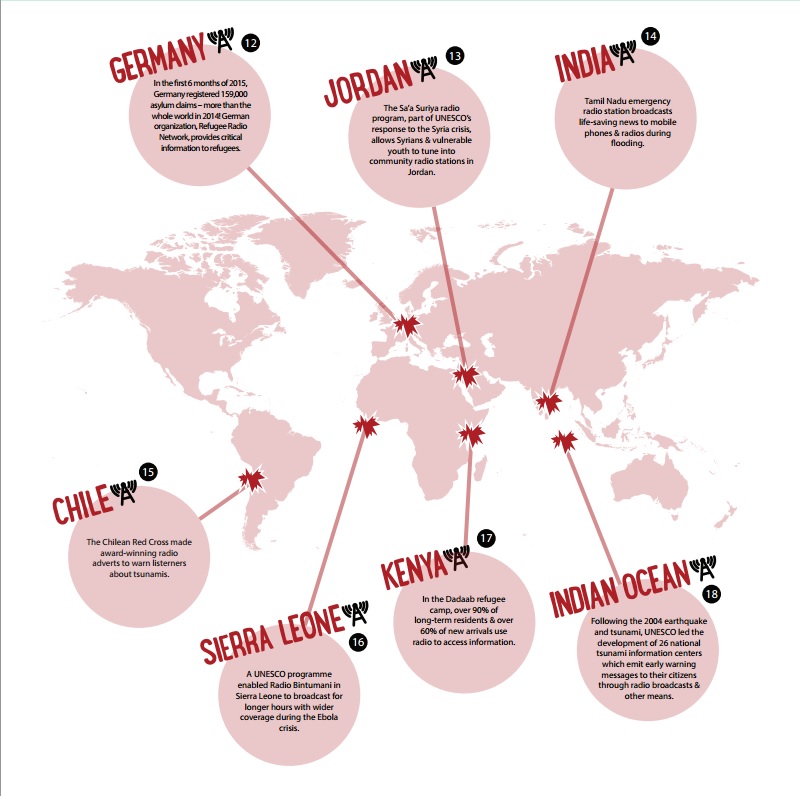
World Radio Day 2016 on 13 February #Infographic

World Radio Day 2016 poster
"This year, the UNESCO theme for World Radio Day is “Radio in Times of Emergency and Disaster”.  Radio still remains the medium that reaches the widest audience worldwide, in the quickest possible time. 
Through World Radio Day celebrations around the world, UNESCO will promote radio in times of emergency and disaster, and put forward the following messages:
Freedom of expression and journalists’ safety should be disaster-proof.
Radio empowers survivors and vulnerable people, whose right to privacy is to be respected.
 
Radio has social impact and provides access to information. People’s right to information should be protected even in times of emergency and disaster.
Radio saves lives. 
 
The immediate accessibility of radio frequencies is essential to saving lives. These frequencies should be protected so they are available in times of emergency.
On 13 February, international broadcasters will broadcast live on UNESCO’s dedicated website, www.worldradioday.org.
 
Through National Commissions for UNESCO Field Offices and partner organisations, World Radio Day will be celebrated worldwide. UNESCO will also provide copyright free articles, audio and video messages from opinion leaders, celebrities, and UNESCO Goodwill Ambassadors related to radio for use by broadcasters on World Radio Day.
UNESCO invites all countries to celebrate World Radio Day by planning activities in partnership with regional, national and international broadcasters, non-governmental organizations, national authorities, the media and the public."

Several themes are addressed this year. See the Infographic below.


Radio empowers survivors and vulnerable people, whose right to privacy is to be respected.

Radio saves lives.

Radio promotes freedom of expression and journalists’ safety should be disaster-proof


Radio has social impact and provides access to information. People’s right to information should be protected.

Radio frequencies should be protected in times of emergency.

READ MORE: World Radio Day 2016

Friday, February 13, 2015

World Radio Day - Archivist Karen du Toit package for Radio Sonder Grense (Afrikaans)


World Radio Day is celebrated for the 4th time this year after it was established by UNESCO in 2011.

"From the news and public debate, music and entertainment, radio informs us , captivate and inspire us in a way that no other medium can." 
Archivist Karen du Toit , who is responsible for the Afrikaans language collection in the SABC Radio Archives, compiled a short compilation of the rich collection of radio material that is being kept by the Archives. The programme was broadcasted on Radio Sonder Grense, the Afrikaans language radio station at the South African Broadcasting Corporation. (The programme is in Afrikaans)

Translation of the text:

"SABC Radio Archives preserve a rich cultural treasure sound that includes the history and time period of the South African Broadcasting Corporation as well as that of South Africa .
This radio treasure is made possible by radio itself, which is the main source of our collection . The radio stations are in turn dependent on the archive that makes the material accessible to be uses again . We keep the radio material on sound tapes, cassette tapes, acetate records, mini tapes, CDs and electronically.
Most of the time we can not just press a button to give access, but we need to collect the audio format in the storage room, and dub it in real time and adapted it to make it available again to programme makers, journalists and the public.

As the Afrikaans archivist, it is very difficult to pick some sound clips to illustrate this rich diversity .

I would like to share the following from our Afrikaans language collection :

1. The first broadcast of Radio Sonder Grense on 28 September 1996, with a soundtrack of the late President Nelson Mandela on the importance of this medium.

2. Our first melodramatic radio drama from the thirties, Liefdesdroom (Love Dream), which was broadcasted on December 15, 1937. 

3. With the 25th anniversary of Radio in 1949 in the Cape a Mister CD Fuchs ( the then Regional Director of Natal ) aspoke on the first days in radio. 

4. The first newscast in Afrikaans from Auckland Park.
              
5. Finally, an audio clip of a portion of a reading of a poem of NP van Wyk Louw : "Image of a youth - pigeon and horse". It is read by Fred le Roux in 1965. The youth poem was chosen because World Radio Day this year focuses on youth and radio. 

6. And sometimes we get recognition as archivists, such as the recent death of André Brink. Colleague Bernard Mashiane came in on Sunday to help with sound clippings for producer Wilna Matthee for a feature on the RSG programme Monitor the next morning."

Wednesday, February 11, 2015

Focus on Youth and Radio for World Radio Day 2015 #WorldRadioDay

Infographic: "Celebrating radio... by youth, for youth... in safety and security"
                                               For World Radio Day 2015 

To help celebrate World Radio Day and
remind ourselves why we need greater participation of young people in radio,
we've made this special Infographic
looking at the three sub-themes of World Radio Day 2015

Related post:

- World Radio Day on 13 February 2015 #WorldRadioDay

Tuesday, February 10, 2015

World Radio Day on 13 February 2015 #WorldRadioDay

World Radio Day
World Radio Day is on 13 February 2015.

The SABC Radio Archives supports this day each year by showcasing our collections from all the SABC Radio Broadcast Services.
We have a duty to preserve this rich heritage, as well as make this collection available for research, re-broadcast and re-use.

Celebrating Radio 
From news and public debate to music and entertainment, radio continues to inform, captivate and inspire us in a way that no other medium can. 
But radio is so much more than a forum for information and entertainment. It reaches more people in more places than any other medium. It’s a bridge of communication for remote communities, developing regions and vulnerable populations, sometimes with no other connection to the outside world. Perhaps no other platform can have the real-time reach between people and across cultures. 
Radio is also the medium best-adapted to navigate the new digital frontiers that are pushing the media and communication into unchartered waters. Technologies such as the Internet, mobile communication and geolocation have shifted the traditional dynamic in which the media operate, with young people at the fore-front of these converging trends, at the same time embracing radio as enthusiastically as ever. 
So let’s come together on 13 February not only to celebrate the importance of radio in our lives today, but to ensure it lives up to its huge potential in the future.

World Radio Day Message: UNESCO Director-General Irina Bokova 


Related posts:

 - The importance of radio – on World Radio Day 2013 #WRD13 #worldradioday

World Radio Day 2013 Press Release


Blog post by Karen du Toit, Archivist, SABC Radio Archives. 

Friday, May 9, 2014

Photos shared by @SABCRadioArc on Twitter for National Archives Week

The following photos were shared on Twitter during National Archives Week in South Africa.

SABC Radio Archives on Twitter: @SABCRadioArc

Photos depicting our different collections, as well as the different audio storage mediums in the radio archives:


Blog post by Karen du Toit.

Monday, February 10, 2014

World Radio Day 2014 on 13 February

World Radio Day 2014
"The World Radio Day seeks raise awareness about the importance of radio, facilitate access to information through radio and enhance networking among broadcasters.
Radio has to be recognized as a low cost medium, specifically suited to reach remote communities and vulnerable people: the illiterate, the disabled, women, youth and the poor, while offering a platform to intervene in the public debate, irrespective of people’s educational level. Furthermore, radio has a strong and specific role in emergency communication and disaster relief. There is also a changing face to radio services which, in the present times of media convergence, are taking up new technological forms, such as broadband, mobiles and tablets. However, it is said that up to a billion people still do not have access to radio today."
                                                     - http://www.worldradioday.org/


UNESCO Director-General video message on the occasion of World Radio Day: 


Also read about World Radio Day here: UNESCO World Radio Day

Friday, July 5, 2013

Nelson Mandela's voice - priceless treasures from the SABC Radio Archives


Nelson Mandela's rich legacy in sound is being preserved in the SABC Radio Archives.

We are reminded of him each day, with posters and framed photos, and his voice from our sound archives.

In 1999 the SABC Radio Archives launched a CD with some of his famous speeches.
The CD is titled: "The voice of Nelson Mandela Extract from famous speeches - original recordings"

One of the speeches was recently used in an Afrikaans drama for Radio Sonder Grense, titled Die Offer (in Radioteater). The speech was from his recital of Ingrid Jonker's poem in 1994, "The Child".

The SABC Radio Archives personnel met him at the launch in 1999. It was a huge honour to shake his hand.

Archivist Elizabeth Mate wore her Mandela t-shirt today, during a time that all is thinking and sending wishes to him for a recovery from a sick bed.


We wish him well this month turning 95!

Tuesday, June 11, 2013

The use of Vine in libraries and archives

Vine is a mobile app that is available on iOS and Android.
It records 6 minute videos that can be shared immediately on Twitter, or be embedded in websites.

I was alerted to it through the ANZ 23 Mobile Things course.

It is very easy to use, and very easy to share.

The following Vines are good examples of how we can use it in our library or archive settings:

From the Appleby Library:


As well as this one:


I made one for the Radio Archives as well:


How can we use Vine for the libraries and archives?

Blog post by Karen du Toit, Archivist in the SABC Radio Archives.

Monday, April 22, 2013

Drama students at the SABC Radio Archives


Third year drama students at the University of Pretoria, doing a course in Radio, visited the SABC Radio Archives on Friday.

The tour was organised by their lecturer, Anna-Marie Jansen van Vuuren.

More of the photos of their visit can be seen on the SABC Radio Archives Facebook page.

They were shown the different analogue and digital audio formats which are being archived and handled in the SABC Radio Archives on a daily basis.

Although the audio equipment and the audio formats are not being manufactured or used on a massive scale any more, the archives are still in need of the skills of capable technicians who look after the equipment.
It is also the task of the archivists to look after their collections of  different audio formats, and to identify the need of collections becoming obsolete because of the formats disintegrating, such as the mini-discs.

Reel-to-reel Studer tape recorder 

The reel-to-reel-tape machine was demonstrated, as well as how the format of reel-to-reel tapes was one of the much safer and robust audio carriers, even than more recently released and recorded audio formats.

Reel-to-reel tape from 1979


Related post:

UP Students in Radio visiting SABC Radio Archives 

Facebook photos:

Drama Students visiting from UP


Blog post by Karen du Toit, Afrikaans Archivist in the SABC Radio Archives.

Friday, April 19, 2013

Archivist Moshe Maghundu at the Khoi and San land claims meeting in Kimberley

Minister Gugile Nkwinti
Archivist and librarian Moshe Maghundu, was at the land claims' discussions between the Minister of Rural Development and Land reform, Min Gugile Nkwinti, and the Khoi and San people.
They want to re-open the lodgement of the land claims.
It was held on 13 - 14 April 2013 in Kimberley.


As an archivist, Moshe Maghundu tries to be at any event with regards the issues and culture of the Khoi and San people; to record and gather material for the archives, which he has started from scratch at SABC Platfontein.


By Moshe Maghundu:

One of the issues at the heart of the Khoi and San people, the land claim, was once again reopened by the minister. A meeting was organised in Kimberley at the Mittah Shiperepere convention centre. The deliberations during these two days were very difficult.

The Khoi and San at the meeting were very frustrated, saying that the government has not recognised the Khoi and San and treating them as if they do not exist at all.
The point was made that the Khoi and San are the first peoples of South Africa, and different sciences prove this point. The rock paintings all over South Africa are such a case in point.

The San demanded an immediate solution to the following:

The land should be given back.
Heritage site ownership should be awarded to the Khoi and San.
Acknowledgement for their traditional leaders and chiefs should be given.

The Khoi and San at the meeting also demanded that government should consult with them before they start planning and implementing with regards their issues.

The following promises were made:

PANSULP - that the Khoi and San language be nationalised and included in the S.A. school curriculum.
Recognition of Khoi and San leadership..
A Khoi and San committee or steering body to be elected to represent them.

Moshe Maghundu interviewing a government official 
I had the privilege to speak to some of the government officials who was very positive in their response. The government acknowledges that mistakes were made when land were taken away from the San peoples (in 1913). After years of government research on this issue, the government want to correct all the wrongdoings. They reopened the land claim issue after it was finalised some years ago as it did not take the Khoi and San people in account.

SABC station X-K FM (107.9) was there for the two days to broadcast from the venue. 
Afrikaans was the language at the conference and only a little bit of English was heard. The recordings was made in Afrikaans.

At some point the frustrations of the Khoi and San made the government delegates uncomfortable. The wisdom of the Minister steered them through this difficult hurdle. 

It needs mention that the Khoi and San land claim re-opening came from the speech President Jacob Zuma made in Parliament. We as the San thank the government for giving us a voice.

Oupa Petrus Vaalbooi (Kalahari) thanking the government
for their involvement
Team X-K FM
Far left: Rena Maghundu (RBF technical producer); Middle, Anna Ndao (X-K FM  presenter):
Right: Joe Mpungo (X-K FMpresenter)

The X-K FM team is acknowledged for a job well done. They had to broadcast in a situation where people were shouting and making noises. 
This is what the station is tasked with: To cover all affairs of the San peoples and to communicate it to those who could not attend.

The final day ended with entertainment and a gala dinner where the SAPS band 
occupied the stage.

SAPS band
Left to righ: Moshe,Rena,Anna and Simon.

Content and photos by Moshe Maghundu.

Blog post by Karen du Toit, Afrikaans Archivist at SABC Radio Archives

Tuesday, April 16, 2013

A quick peek in the SABC Radio Archives: I am holding... (Channel Africa)


A series of blog posts highlighting the scope of our collections.

Elizabeth Mate is the Channel Africa Archivist in the SABC Radio Archives.

She looks after the collections of Channel Africa Radio. It includes various languages, English, Portuguese, Swahili, Chinyanja and Silozi as well as French.

At this moment she is working on…

I am cataloguing an interview of Mr. Kachana Kachana of the Silozi Service who is speaking to Professor Patrick Walusiku Mataka of Zambia about the importance of trees/forests in the world..


Related posts:

The Weekly Archivist interview: Channel Africa collection


Blog post by Karen du Toit, Afrikaans Archivist in the SABC Radio Archives


Wednesday, March 27, 2013

UP Students in Radio visiting SABC Radio Archives

UP third year students with their lecturer.
Anna-Marie Jansen van Vuuren (far right)
The University of Pretoria third year students doing a course in radio, visited the SABC yesterday. They also visited the SABC Radio Archives.

Johann Greyling, the acting manager and team leader of cataloguing, gave them an introduction to the SABC Radio Archives and showed them some of the audio formats that are still being used.

Johann Greyling addressing the students

Johann Greyling

Showing the students a mini-disc in the backlog storeroom

Showing a reel-to-reel tape
UP students at SABC Radio Archives
Johann Greyling demonstrating
a reel-to-reel tape machine in the studio

There are some photos posted on SABC Radio Archives's Facebook page as well:
SABC Radio Archives

Wednesday, February 13, 2013

The importance of radio – on World Radio Day 2013 #WRD13 #worldradioday


As seen from the perspective of the SABC Radio Archive archivists.

This is the second year in a row that World Radio Day is being celebrated worldwide.
It is a day to highlight the importance of radio, and for broadcasters to make a connection to cooperate.

World Radio Day and UNESCO are focusing on the “promotion access to information and freedom of expression over the airwaves”

The SABC Radio Archives in South Africa collects and receives radio material from all South African Broadcasting Services (SABC) public broadcast services (PBS).
The material is catalogued and stored in various repositories across South Africa.


The archivists at SABC Radio Archives in Johannesburg have the following to say about the importance of radio:

Refiloe Jele (Acting Manager & Music Archivist): My history and my culture on record!

Johann Greyling (Sport Archivist & Team Leader: Cataloguing): Radio is the most important medium of communication in the world; it reaches where TV, the internet and no print medium can dream to reach.

Obakeng Phiri (Archivist: Sound Restoration): 1. Radio as a wealth of information is always readily available; 
2. Radio continues to play an important role in information sharing; and,
3. Radio broadcasts provide real-time information, broadcasting 24 hours a day to provide the most recent updates to listeners.

Retha Buys (Request archivist & Springbok Radio custodian): Radio is your any-time  anywhere companion and memory….

Morongwa Mokwena (English archivist): I think radio is a powerful tool for social change as it provides access to information . . .addresses issues for social change like gender inequality, HIV etc. and in this way it empowers society.

Joseph Lobeko (Archivist: Sound Restoration): Old preserved records of historical nature are re-purposed by being broadcasted on radio; e.g. the Mandela treason-trial speech is still relevant today in nation-building.  

Peter Raseroka (Ikwekwezi archivist): Radio is important because it updates you each hour on  news and programmes that are educational, religious, youth orientated and sports, to name a few. Radio people also watch television, but sometimes turn down the audio to listen to radio simultaneously, especially with sports.  Blind people are enjoying radio because they are able to visualize more. Radio gives you more information on what's happening! 

Elizabeth Mate (Channel Africa archivist): Radio is very important in the rural areas, especially where people don’t have television. It helps tremendously with death announcements!

Ntokozo Khanyile (News & Actuality archivist): Radio tells various stories and brings news to the listeners as soon as they are available. Radio Archives bridges the history gap and makes all news accessible to all generations.

Nare Monyai (News, actuality & sport request archivist): Radio broadcasting is the modern instrument for informing, educating and entertaining listeners, even in remote areas of the country. 

Karen du Toit (Afrikaans archivist): Radio records the heritage of the cultures in South Africa. The radio archives are vital to store this memory for future generations.

Tuesday, February 12, 2013

Springbok Radio - a radio station lives on because of their dedicated listeners

A guest post contribution for the second World Radio Day in 2013.


Springbok Radio, a former radio station of the South African Broadcasting Corporation in South Africa, closed its transmission at the end of 1985. It was the first commercial radio station of the SABC.

During the time of 1950 -1985 there was no dedicated effort to collect all the radio programmes for archives, and most of the programmes were recorded over one another to save resources, which was mostly in the format of reel-to-reel tapes.

The SABC Radio Archives have found some of these recorded gems in the archives, but it was only by the passion of the listeners that a large collection of the Springbok Radio material was saved.


The guest post can be found at Lifeline Energy: 


Tuesday, January 22, 2013

World Radio Day 2013 Press Release

World Radio Day 2013

The second World Radio Day is upcoming on 13 February 2013.

The Press Release:

February 13 is the day proclaimed by UNESCO and endorsed by the United Nations General
Assembly to celebrate Radio as a medium; to improve international cooperation between
broadcasters; and to encourage major networks and community radio alike to promote access
to information and freedom of expression over the airwaves. 

UNESCO encourages all countries to celebrate World Radio Day by planning activities in partnership with regional, national and international broadcasters, non-governmental organizations, the media and the public.

The International Committee for the World Radio Day is constituted by agreement
among the most representative broadcasting organizations. Its purpose is to internationally
promote the celebration of the World Radio Day, whom the first edition will be held February
13, 2013 by means of different activities.

This Committee invites all public, private, online and community Radio organizations as well as
Radio professionals and listeners worldwide to participate in a global campaign and join voices
to tell the world why Radio still is the greatest media!

www.wrd13.com the World Radio Day International Committee web platform organizes
sound item exchanges in order to promote this medium (1 minute maximum). 

You are invited to produce and to send to this website your posts, whatever your link may be with the Radio world (public Radio, private Radio, community Radio, independent producer, listener …).

All international Radio organizations are also invited to actively ask their listeners to
participate by publishing the promo banners on their website or by sharing the link on their
Facebook or Twitter page. WRD13 could be the perfect opportunity to strengthen radio
relationships with listeners!

Any Radio organization will be able to freely download any content available on the platform
and celebrate World Radio Day by broadcasting all day, on Wednesday 13 February 2013,
audio messages on the importance of Radio from all over the world.

contact: info@wrd13.com


--------------------------------------

The SABC Media Libraries will also make a contribution on the World Radio Day on their website.
We will keep you updated.

Friday, May 4, 2012

Hand over of Springbok Radio archive material to SABC


Springbok Radio 

Media release:

Tuesday 08 May 2012 will officially mark the handover of the archives of the Springbok  Radio Preservation Society  of South Africa  to the SABC.

When Springbok Radio opened in 1950 it had only three medium wave transmitters, but by October 1951, it was broadcasted to all the densely populated areas of the then Union of South Africa on 11 transmitters. Eric Egan was the first voice on Springbok Radio with his breakfast show.   From the start it was a resounding success- announcers found themselves catapulted into the limelight and they were mobbed by eager fans when they made public appearances.
Springbok Radio created a new vehicle for local artists and writers. Private production houses were churning out episode after episode of soap operas such as “From Chrystal with love”, “No place to hide” and ‘Liefdeslied”. There was also more than enough comedy to satisfy listeners. Shows such as the Caltex Loudspeaker Show, Next Stop – Makouvlei, Taxi,The Navy Lark, Friends and Neighbours and the Men from the Ministry became cult hits, while shows like Springbok Radio Top 20 offered music to the ears of the listeners.
Voices from Springbok Radio includedPip Freedman, Paddy O Byrne, Esme Euvrard, Clark McKay, Danie Smuts, Gordon Mulholland, Brian O’ Shaughnessy, Dorianne Berry, David Gresham, Mervyn John, Robin Alexander, Dana Niehaus, Douggie Laws, Denis Smith and Bea Read, to name but a few. It was a sad day for many listeners when Springbok Radio broadcast for the last time in 1985. 
Unfortunately, due to many reasons, much of the material was not archived, although a lot of the material was kept by producers, presenters, or recorded in listener’s homes. Since the closure of Springbok Radio in 1985, interest by the public grew and the nostalgic value of old time radio increased over the years. The Springbok Radio Preservation Society of South Africa was formed in 2002.  Mr Frans Erasmus, the main drive behind the initiative, dedicated his life to collect as much Springbok Radio material possible, either from producers and production houses, or from private collectors, both locally and overseas. 

The SABC Radio Archive has been working closely with The Springbok Radio Preservation Society of South  Africa over the last few years to assist in making the collection accessible to the public.  Since most of the material belongs to the SABC, an agreement was reached with Mr Erasmus to grant him permission to look after the collection, and to make the material accessible via a website and a digital stream.

The SABC in return handled all queries relating to Springbok Radio and ensured that copyright was not violated. In addition, copies of the Springbok Radio collection were handed to the SABC on a regular basis to be catalogued and added to the SABC databases. The mutual understanding was to transfer the complete collection back to the SABC, for preservation and as part of the SABC’s radio broadcast legacy, while the Springbok Radio Preservation Society would maintain the website and digital stream under the auspices of the SABC.

Recently Mr Erasmus decided to hand the collection in its entirety, including the website and the digital stream to the SABC Radio Archives, and agreed to assist with and oversee the process of transferring the digital stream and the website, as well as advising the preservation of the material and the information pertaining to the material.

As a gesture to thank Mr Frans Erasmus and the Springbok Radio Preservation Society for their contribution towards the preservation of one of the most nostalgic radio stations in South Africa, the SABC Media Libraries will host a formal function where tribute can be paid to Springbok Radio and the work Mr Erasmus has done.  It is exciting to know that a collection, once outside the SABC’s domain and almost forgotten, will return to its rightful place in the SABC, be looked after, and be accessible for the future.

The theme of the event will be reminisced of the era of Springbok Radio and it is hoped some of the previous presenters will grace the event, for this also serves to thank everyone ever involved in Springbok Radio for their contribution to brighter broadcasting.

Media Enquiries: Mr. Kaizer Kganyago. Cell: 082 306 8888

Monday, February 13, 2012

World Radio Day today #WorldRadioDay

Today is World Radio Day, a celebration of the role and function of radio in the lives of people on the planet.
The day is endorsed by UNESCO.

The official web page for World Radio Day states the following about the focus of the day:

"The World Radio Day seeks raise awareness about the importance of radio, facilitate access to information through radio and enhance networking among broadcasters.
Radio has to be recognized as a low cost medium, specifically suited to reach remote communities and vulnerable people: the illiterate, the disabled, women, youth and the poor, while offering a platform to intervene in the public debate, irrespective of people’s educational level. Furthermore, radio has a strong and specific role in emergency communication and disaster relief. There is also a changing face to radio services which, in the present times of media convergence, are taking up new technological forms, such as broadband, mobiles and tablets. However, it is said that up to a billion people still do not have access to radio today."

The South African Broadcasting Corporation (SABC) is also taking part in the celebrations:


SABC Radio will be celebrating World Radio Day with all South Africans, informing them about its history and its importance in our daily lives. The SABC Radio network reaches over 25 million people on a weekly basis with its radio platforms positioned to serve all South Africans including Channel Africa, an International Public Service Radio Station whose role is to contribute to the development agenda of Africa." 
"Radio is the pioneer of all electronic media. It is as relevant today as it was 75 years ago. Radio is still the medium of choice as it still commands the highest penetration as a medium in South Africaand the developing world.
SABC Radio, for the past 75 years, has assisted in informing, educating and entertaining South Africans from all walks of life, said Lesley Ntloko the acting Head of Radio of the SABC. On the 13th of February stay tuned to your favourite SABC radio station and join in as we reflect on special moments and memories that SABC Radio has created."                             - SABC Radio

SABC Radio Archives, the archives which collects and receives material from all the SABC Public Broadcast Services (PBS) Radio Services, also reflects on the importance of this day.
SABC Radio has been broadcasting for 75 years, and we have audio material covering the history and the culture of the same period, collected, catalogued and "stored in the various archive repositories across the country."

The SABC Radio Archives preserves material for the following reasons:


  • To preserve SABC broadcasts and raw material as a corporate function;
  • To be of service as a well-organised source of broadcast material to the SABC;
  • To preserve permanently highlights in the history of the development and broadcast patterns of broadcasting in South Africa;
  • To bequeath to future generations an audio-image of South Africa at certain periods as it was portrayed by the SABC;
  • To provide researchers with information and facts on sound carriers that are not available in any other form;
  • To preserve, as part of the National Broadcaster’s function and as far as possible, complete recordings of the South African culture legends and oral traditions, including a comprehensive set of nature and habitat sounds of South Africa
We truly preserve some of the most precious memories of our history in radio. 
Our existence is because of the medium of radio, a medium which are able to reach more people than any other!

Happy World Radio Day!

Happy listening!


Post by Karen du Toit, Afrikaans Archivist in the SABC Radio Archives 


Thursday, October 27, 2011

Between Stations....


Between stations, radio stations, that is, there has always been a lot of development and movement here at the SABC.  Broadcasting never has been and never will be a static affair.  If you hear static, well, turn the dial, the radio-friend is there somewhere!  


Recently I had to research the Radio Stations of the SABC, and thought to share a bit of what I learnt, for interest sake.  Please feel free to share YOUR memories of SABC Radio, we would love to hear!


Radio Stations of the SABC:

·         A Programme / English Service (1936/08/01-1985/12/31)
o   Radio South Africa (1986/01/01 – 1995/02/28)
o   SAFM (1995/03/01)
·         B Programme / Afrikaanse Diens (1937/10/27 – 1985/12/31)
o   Radio Suid-Afrika (1986/01/01 – 1991/09/30)
o   Afrikaans Stereo )1991/10/01 – 1996/09/30)
o   Radio Sonder Grense / RSG (1996/10/01)
·         Radio Lourenco Marques / LM Radio (1935 / 1972/06/01 by SABC – 1975/10/12)
o   Radio 5 (1975/10/13 – 1992)
o   5 FM (1992)
·         The Voice of South Africa (1951/12)
o   Radio RSA (1966/05/01)
o   Channel Africa (1992/10) – funded by the State
·         Springbok Radio (1950/05/31 – 1985/12/31)
·         Radio Bantu (1960/01/01)
o   Radio Sesotho (1962/01/01)
§  Lesedi FM (1996)
o   Radio Zulu (1962/01/01)
§  Ukhozi FM (1996)
o   Radio Setswana (1962/06/01)
§  Motsweding FM (1996)
o   Radio Lebowa (1962/06/01)
§  Thobela FM (1996)
o   Schools  Radio Service (1964)
o   Radio Tsonga (1/21965)
§  Munghana Lonene FM (1996)
o   Radio Venda (1965)
§  Phala Phala FM (1996)
o   Radio Xhosa (1966)
§  Umhlobo Wenene FM (1996)
o   Radio Swazi (1982)
§  Ligwalagwala FM (1996)
o   Radio Ndebele (16/3/1983)
§  Ikwekwezi FM (1996)
·         Radio Good Hope / Radio Goeie Hoop (1965/07/01 – 1992)
o   Good Hope FM (1992)
o   Also Good Hope Stereo / Goeie Hoop Stereo
·         Radio Ovambo (1969/11 – 1979/05) – in SWA till SWABC/SWAUK came into being
·         Radio Herero (1969/11 – 1979/05) – in SWA till SWABC/SWAUK came into being 
·         Radio Damara Nama (1969/11 – 1979/05) – in SWA till SWABC/SWAUK came into being 
·         Radio Kavango (1972/02-1979/05) – in SWA till SWABC/SWAUK came into being 
·         Radio Lotus (1983/01/08)
o   LotusFM (??)
·         Radio Metro (1986/09/01 - 1998)
o   Metro FM (1998)
·         Radio 2000 (1987/01/01)
·         X-K FM (2000/08)
·         CKI FM (2002/09 by SABC, prior Ciskei station)
o   TruFM (2008)
·         Radio Allegro (1985/06/01 – 1993)
·         Radio Orion (1982/05/01-1990/12/31)

RadioSeparate channels funded by the state and managed on behalf of the state by the SABC:

·         Radio Bob
·         Radio Sunshine / Radio Sonskyn

Stations sold by the SABC in 1996:

·         Radio Highveld/Radio HoĂ«veld (1964/09/01- 1988/04/01) 
o   Highveld Stereo / HoĂ«veld Stereo (1988/04/01)  (current – NOT SABC) – sold in 1996
o   Radio Jacaranda / Jakaranda (1985/07/01 -1994/05/31)
o   Jacaranda/Jakaranda 94-97 FM (1994/06/01-??) 
§  Jacaranda/Jakaranda Stereo (??) – Sold in 1996
§  Jacaranda / Jakaranda FM (current – NOT SABC)
·         Radio Port Natal 
o   RPN Stereo
o   East Coast Radio (Current – NOT SABC) – Sold in 1996
·         Radio Oranje (1985/06/01 – 1996) – Sold in 1996
o   OFM (current – NOT SABC)
·         Radio Algoa (1986/01/01 – 1996) – Sold in 1996
o   Algoa FM (current – NOT SABC)
·         Radio Kontrei (1990-1991) 
o   Kfm (1991) (Current – NOT SABC) – sold in 1996