Showing posts with label culture. Show all posts

Wednesday, April 1, 2015

The Kalahari Desert Festival 2015, Andriesvale

By: Moshe Maghundu
Archivist and Librarian, Platfontein, Northern Cape


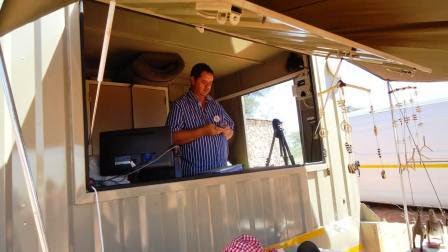
On Thursday, 19 March, the X-K FM broadcast team got the privilege again to do the Kalahari Desert Festival 2015 (KDF 2015).

Left: Simon Hasjenda (Programme producer); Moshe Maghundu (Archivist);
Reinhardt Kampunda (Presenter)
Right: Jeta Manuel (Presenter)
[Camera: Rena Maghundu (Technical producer)]
It is an opportunity to do stories, interviews and oral history for SABC Platfontein Archives, but it does not come easy due to budgetary constraints.

This is the third festival that Moshe Maghundu attended where he could gather a sizeable amount of material for broadcast and for the Archive. Speaking to people around the festival is easier than speaking to them at home where they are asking for monetary compensation before telling their stories. He is appreciative of the fact that the people came to talk to him for free.


The broadcast location was centred right in the middle of all activities It was very easy getting hold of people for interviews.


They got hold of Andries Steenkamp on the first day. He is a respected leader from the area and he is one of the organisers of the Kalahari Desert Festival 2015. He has a very strong vision of the KDF and how he want the festival to survive in future.


The tent was used as a lecture venue for the three San languages; !xun, Khwe an !khomani. It was amazing to observe how encouraged the young people were in learning these languages.

The beauty of the Kalahari: dry, with grasses and plants
which can only grow in the Kalahari

One of the challenges they had was the booking of Telkom lines. Telkom could not give them any lines because of birds making their nests on these poles which became heavy and breaks the poles.

Thanks to technology, they used the mobile devices Comrex for Broadcast.


At the festival there were many activities which kept the youth entertained, with drama performances, poetry and music.


There were young ladies modelling for the crowd.


The ladies team from Platfontein also took part in the traditional dance performances. This was very encouraging seeing the young people interested in the cultural affairs.


Moshe Maghundu arranged for an interview with one of the organisers of the Kalahari Desert Festival. She spoke on issues of the San people being exploited. Researchers and film crews do not compensate fairly for research and visual material being shot in the area.


Police and medical crews were on standby in case of emergencies.

Day 2 of the broadcast by X-K FM

They managed to do a number of interviews with Andries Steenkamp. Moshe Maghundu helped out to make sure that everything went well with the broadcasts before going off  "sound hunting".


Children were also given the opportunity to enjoy the festival with jumping castles. The day was cloudy with some drops of rain, but the wind was one of the main challenges. They were thankful that the Gazebo was not blown away.


There was also a session of storytelling around the fire where by all San groups came together to tell their stories. It was a very exciting experience for all!

-------------------------

Thanks to the following people for believing in the work that's been done:
- Regina Beregho, the station manager of X-K FM - for taking the initiative to arrange for this trip for Moshe Maghundu. It would not have been possible without her and he would not have been able to do his work in the Kalahari.
- Hennie Swart - for all the financial support. Thanks for believing  in the development of the San people by supporting the X-K FM Archives: "Baie dankie Hennie, ek waardeur alles!"
- Colleagues: Simon Hasjenda, Rena Maghundu, Reinhardt Kampunda and Jeta Manuel - "Thanks for the co-operation you gave. I really enjoyed working with you all.You all are hard-working and we all had one mission to accomplish, and that was to do our best for our station X-K FM".


Related posts

- The Kalahari Desert Festival 21 - 23 March 2014 > "Sound Hunting" for archival purposes

X-K FM archivist at the Kalahari Desert Festival

Wednesday, April 16, 2014

The Kalahari Desert Festival 21 - 23 March 2014 > "Sound Hunting" for archival purposes

SOUND HUNTING 
by Moshe Maghundu
Archivist: SABC Platfontein 

The Kalahari Desert Festival took place for a second time in the Kalahari at Andriesvale, ten kilometres from Ashkam. This event is very historical in nature to the SAN people as it brings together all San people from different countries with their traditional festivities.


The San people from Platfontein, the Kalahari, Upington and others from the Western Cape took part as the festivities started on the evening of Friday, 21 March, on Human Rights Day.

Moshe Maghundu was there with a crew to do “sound hunting”. He was able to host storytelling sessions with the Kalahari people and others. The people gave their full cooperation. He faced challenges with some people expecting to be reimbursed for their oral contributions. He complied out of his own pocket because of his love for the project. He understands and put a great value on their contributions for heritage and archival purposes.

Station X-K FM covered the event live from its opening till the evening of the last day Saturday 22 March.They were also responsible for arranging some of the interviews which Moshe recorded.

Mr Markus Jetembo        Presenter
Mr Joe Mpungo               Presenter
Mr Piorro Mushavanga   Producer
Me Rena Maghundu       Technical Producer
Mr Moshe Maghundu     Archivist

X-K FM
X-K FM struggled with some technical difficulties, but luckily the technical producer took care of the problems.


It is highly appreciated that Mike Nemane provided the gazebo in which the broadcast took place.

The challenges of the Kalahari sand did not put a damper on the uplifting spirit of the festival.
Moshe Maghundu was working non-stop to get the people to tell their stories. Although it was hot, time was limited for him to get all the interviews.

Moshe Maghundu during a short break
before taking up the Marantz recorder again
DRAPJJ STARS
There were music performances in the main tent. The group from Platfontein, called the DRAPJJ STARS, with hip hop and rap music, mixed it up with the San language and the English language.

DRAPJJ STARS
The moment DRAPJJ STARS stepped  on the stage, every one in the surrounding areas ran to the tent to watch their performance.

X-K FM presenter interviewing young people
On the evening of the last day the presenter interviewed  young people about their  experiences at the Kalahari Desert Festival 2014. The presenters did an excellent job.


The donkey carts were the only transport allowed at the venue. People had to pay to be transported around in the area and it was found to be very trustworthy.

Hennie Swart
Special thanks goes to the main man, a friend, organiser and everything of the Kalahari Desert Festival.
He started the initiative for the San people to share their cultural heritage. His name is Hennie Swart, the only white man with a black surname. He drives a black Isuzu truck and likes wearing his black t-shirt.

Also thanks to the following people for making the trip a success:

Me Regina Beregho, X-K FM station manager.
Mr William Heath, Line Manager RBF.

Monday, February 10, 2014

World Radio Day 2014 on 13 February

World Radio Day 2014
"The World Radio Day seeks raise awareness about the importance of radio, facilitate access to information through radio and enhance networking among broadcasters.
Radio has to be recognized as a low cost medium, specifically suited to reach remote communities and vulnerable people: the illiterate, the disabled, women, youth and the poor, while offering a platform to intervene in the public debate, irrespective of people’s educational level. Furthermore, radio has a strong and specific role in emergency communication and disaster relief. There is also a changing face to radio services which, in the present times of media convergence, are taking up new technological forms, such as broadband, mobiles and tablets. However, it is said that up to a billion people still do not have access to radio today."
                                                     - http://www.worldradioday.org/


UNESCO Director-General video message on the occasion of World Radio Day: 


Also read about World Radio Day here: UNESCO World Radio Day

Thursday, May 16, 2013

X-K FM radio drama in the local San language of Platfontein

Story by Moshe and Rena Maghundu
Librarian/Archivist and Recording Technicians at SABC Platfontein


TUSSEN WASGOED DRADE  (Between washing lines)


X-K FM

 X- K FM, the radio broadcasting facilities (RBF), in partnership with SASI,  introduced a radio drama called "Tussen wasgoed drade" (Between washing lines). 

SABC RBF
SASI

It is recorded in the local San language of Platfontein (!Xun & Khwe) as well as in the San language of the Kalahari (N/u) and Afrikaans.


The drama addresses social issues in the community and also educates the listeners on health matters.  


The script writer Alme Swart was exposed to the San communities since her birth as her parents were teachers at Schmidtsdrift San Combined School. It was not easy to start with the script she said. She had to drive through the community to get the feeling of the kind of living of the San Communities.

Platfontein actors – Xun & Khwe
Actors busy recording in X-K FM studio
The youth of Platfontein are very passionate about educating the people of Platfontein through their drama message. The drama is the most listened to on the station and is aired every Wednesday after the 16:00 pm news with a repeat on Sunday at 12:00 pm.


Kalahari actors– Andriesvale
“Ek voel sommer jonk hier tussen die kinders," says Ouma Geel. (I feel very young here with the young people.)
 She’s the only N/u speaker among the Afrikaans speaking youngsters. She translated the character of Charlene, the widow, and Juliet’s best friend in the N/u language.
"Ek is so bly dat die Here my gespaar het om vandag my taal op te neem vir my afstammelinge," was Ouma Geel’s words. (I am so glad that I was saved to record my language for my descendants.)
She also does part-time translations in her language.


The production team had the following comments:
 It was not easy couching and mentoring junior actors who do not have a drama background. The SABC team had to sit in at their rehearsal sessions. They started recording this drama in Afrikaans at Platfontein. After they met with the Kalahari actors who only speak Afrikaans, they had no other option but to change the one of Platfontein in the two languages of Platfontein which is the !xun and Khwe.

They had to work extremely hard to accomplish this product, especially with the editing part.

Special thanks to the SABC for the equipment and SASI for the CD's to get this product to the relevant people. 
The wish is that we get more sponsorships to run such a project continuously.
Special thanks, as well, to Billies Pamo (Project manager at SASI) for managing the team.

The X-K FM programme producers, Piorro Mushavango and Simon Hasjenda for the excellent promos, and the programme manager, Malton Edburg, for allowing the drama to be on air.
Lastly, Me Regina Beregho of X-K FM, for seeing the value in this drama and her continuous support.

Here is a promo of the drama, in the local San languages:

- Alme Swart (Script writer)
- Moshe Maghundu (Recording Technician)
 -Rena Maghundu   (Technical producer, editing & packaging)


Blog post by Karen du Toit, Afrikaans Archivist in the SABC Radio Archives.

Friday, April 19, 2013

Archivist Moshe Maghundu at the Khoi and San land claims meeting in Kimberley

Minister Gugile Nkwinti
Archivist and librarian Moshe Maghundu, was at the land claims' discussions between the Minister of Rural Development and Land reform, Min Gugile Nkwinti, and the Khoi and San people.
They want to re-open the lodgement of the land claims.
It was held on 13 - 14 April 2013 in Kimberley.


As an archivist, Moshe Maghundu tries to be at any event with regards the issues and culture of the Khoi and San people; to record and gather material for the archives, which he has started from scratch at SABC Platfontein.


By Moshe Maghundu:

One of the issues at the heart of the Khoi and San people, the land claim, was once again reopened by the minister. A meeting was organised in Kimberley at the Mittah Shiperepere convention centre. The deliberations during these two days were very difficult.

The Khoi and San at the meeting were very frustrated, saying that the government has not recognised the Khoi and San and treating them as if they do not exist at all.
The point was made that the Khoi and San are the first peoples of South Africa, and different sciences prove this point. The rock paintings all over South Africa are such a case in point.

The San demanded an immediate solution to the following:

The land should be given back.
Heritage site ownership should be awarded to the Khoi and San.
Acknowledgement for their traditional leaders and chiefs should be given.

The Khoi and San at the meeting also demanded that government should consult with them before they start planning and implementing with regards their issues.

The following promises were made:

PANSULP - that the Khoi and San language be nationalised and included in the S.A. school curriculum.
Recognition of Khoi and San leadership..
A Khoi and San committee or steering body to be elected to represent them.

Moshe Maghundu interviewing a government official 
I had the privilege to speak to some of the government officials who was very positive in their response. The government acknowledges that mistakes were made when land were taken away from the San peoples (in 1913). After years of government research on this issue, the government want to correct all the wrongdoings. They reopened the land claim issue after it was finalised some years ago as it did not take the Khoi and San people in account.

SABC station X-K FM (107.9) was there for the two days to broadcast from the venue. 
Afrikaans was the language at the conference and only a little bit of English was heard. The recordings was made in Afrikaans.

At some point the frustrations of the Khoi and San made the government delegates uncomfortable. The wisdom of the Minister steered them through this difficult hurdle. 

It needs mention that the Khoi and San land claim re-opening came from the speech President Jacob Zuma made in Parliament. We as the San thank the government for giving us a voice.

Oupa Petrus Vaalbooi (Kalahari) thanking the government
for their involvement
Team X-K FM
Far left: Rena Maghundu (RBF technical producer); Middle, Anna Ndao (X-K FM  presenter):
Right: Joe Mpungo (X-K FMpresenter)

The X-K FM team is acknowledged for a job well done. They had to broadcast in a situation where people were shouting and making noises. 
This is what the station is tasked with: To cover all affairs of the San peoples and to communicate it to those who could not attend.

The final day ended with entertainment and a gala dinner where the SAPS band 
occupied the stage.

SAPS band
Left to righ: Moshe,Rena,Anna and Simon.

Content and photos by Moshe Maghundu.

Blog post by Karen du Toit, Afrikaans Archivist at SABC Radio Archives

Monday, April 8, 2013

Late Oupa Dawid Kruiper’s dream comes true


From left: Billies Pamo (South African San Institute), Simon Hasjenda (X-K FM producer)
 and Riano Nduve (
X-K FM presenter) at the water tap
in Andriesvale


By Moshe Maghundu
Librarian/Archivist of  X-K FM community radio station which broadcasts in !Xu and Khwe from SABC Platfontein.


Our late hero, Oupa Dawid Kruiper, had been fighting for a very long time for development around Andriesvale. 
He was a San elder and leader of the Khoisan community in the southern Kalahari Desert. He was also one of the main players in the land claim by the #Khomani San. He died in June 2012, and the burial service of  Oom Dawid Kruiper was recorded for the archives as well.

One of the major problems was not having drinking water sources. The community had to dig wells to get water. After his death, and media coverage of the challenges the communities face , his dream about running water became a reality.  

The team visited the family during the Kalahari Desert Festival.

The house of Dawid Kruiper’s sister
Poverty remains the biggest problem for these people. They struggle each day for food. As Bushmen they still try to survive from the Kalahari sand dunes, which is not an easy thing to do.
A positive development by the government is that the team of SASSA (social grants) is actively involved by registering the people around Andriesvale. We saw them working there, and we thank the government for their involvement and the good work of the acting premier of the Northern Cape.

From right, Mr Billies Pamo, Moshe Maghundu,
the Kruiper’s sister with her daughter, Mr Simon Hasjenda, Mr Riano Nduve.
I thought it will be good to take a photo with the Kruiper family as their issues of poverty has touched my heart. The hope remains that their problems would be addressed!

I told the X-K FM team of the water issues before we visited, and when they saw the tap, they all were very happy to see it!  (See photo on top)


I have been waiting for this opportunity to witness it myself. I visited the house of late Oupa Dawid Kruiper around 25th March 2013. I could see that the water that Oupa Kruiper had been craving for, had finally became a reality. 
I could even drink from the tap outside his house. 

It is a pity that Dawid Kruiper himself could not witness it, but his family appreciates the legacy he has left behind!


Related posts:


Blog post by Karen du Toit, Afrikaans Archivist at SABC Radio Archives.


Friday, June 15, 2012

Knowledge Management, the good, the bad & the ugly

Roland Wagner at KM Seminar
UJ Dep of  Information & Knowledge Management


Notes from a seminar by Roland Wagner (Project coordinator at Damietta Peace Initiative) about Knowledge Management, with specific reference to organizational culture. 

The seminar on 31 May 2012 was hosted by the Department of Information and Knowledge Management at the University of Johannesburg (Kingsway Campus).

Roland Wagner has extensive experience with regards Knowledge Management. See his biography that is copied from the invite below.


Some notes that was taken at the seminar:

- "Knowledge is a social construct - generated in collaboration and interaction with others"

- Culture comes to play in this social interaction! 

- A company's culture is the reflection of the macro-economic culture.

- "Good" or "bad" culture can be identified by the impact of corporate culture.
  Positive which makes it an enabler in the organization
  Negative where it is seen as a barrier in the organization.

- The role of Knowledge Management is to create an enabling environment. It can't be done    without the active role of Human Resources. They should be involved!

- KM is multi-disciplined and there should be a marriage between all teams.

- Understanding of the sub-cultures (units, regions, departments) within an organization enables KM.

- Leadership has a direct impact on the culture in an organization.

- KM needs to map the organization's existing culture.

- Tacit knowledge very important, especially with regards risk management. KM & HR need to work closely on this!

- Storytelling as a KM output extremely important; although it is time-consuming.

- KM should be sensitized continuously in an organization.

- Roland Wagner believes it is sometimes better to getting consultants in for KM.

- Another important learning outcome: Knowledge sharing should not be rewarded! It should be part of the organizational culture. The employee's thinking is the organization's intellectual property.

- KM should create a culture of trust in the organization. It is done by communities of practice, office retreats, social events, open environment, and knowledge cafés.


Roland Wagner suggested some KM vs Culture Videos on Youtube:


It's All About Culture - What is Corporate Culture?

Overcoming Resistance to Change - Isn't It Obvious?

What is Organisational Culture ? Why Culture Matters To Your Organization


Notes by Karen du Toit, Archivist, SABC Radio Archives.


Roland Wagner Biography:
"Roland holds a Master’s degree in Information and Knowledge Management and currently manages knowledge management initiatives at Damietta Peace Initiative, a non-profit organisation. Roland’s previous KM role at Anglo American is to implement knowledge management initiatives for various business units including transportation, safety and sustainable development, Anglo Research and Anglo American Projects. Roland’s key role for KM at Productivity SA was to introduce a holistic KM inititiative within the organisation, including the development of a KM strategy.  The KM strategy was guided by the research (qualitative and quantitative) approach that resulted in a “current assessment report” (CAR). He was also project leader in the development of a knowledge management strategy for the Department of Science and Technology (DST) as well as the Film and Publication Board (FPB).  The development of these KM strategies also included knowledge and information audits, as well as evaluating the feasibility of Enterprise Content Management (ECM) systems. Roland also mentored and coached the Anglo American engineering team in applying Lessons Learnt projects.  This activity took place in 2008 where he held a Lessons Learnt workshop. He is also a member of the Society of Competitive Intelligence Professionals (SCIP).
Completed projects include:
Development of the knowledge management strategy for Productivity SA
Development of the knowledge management strategy for the Department of Science and Technology
Lessons learned project and knowledge management strategy for the Film and Publications board
Knowledge management consultant to assist Kumba Iron Ore (Anglo American) in completing three knowledge management projects. The projects involved are part of knowledge mapping within Kumba’s supply chain: A lessons learnt project within Kumba’s Sishen Expansion Project (SEP) and the development of a briefing and de-briefing tool for Kumba’s Human Resource department as well as developing a benchmarking project plan for Kumba Iron ore’s heavy mining equipment.
Project manager in developing an agricultural information system for the Department of Agriculture in the North West Province.
Local Economic Development (LED) expert to assist the Government of Limpopo in establishing an LED Resource Centre in the Limpopo Province of South Africa. This is an EU funded project (as part of the larger EC supported LED Program for Limpopo) and work entailed conducting research, assisting the development of a Business Plan for the Centre, benchmarking similar centre locally and internationally and capacity building support to the hosting institution.
Team member on the Manstrat consulting team that assisted the Free State Department of Agriculture in developing a Training Strategy for its Non-Formal Training Unit (VET program).
Team member on the Manstrat project team that assisted the Department of Agriculture in the North West Province to undertake feasibility studies and develop business plans (turn-key projects) for a total of 15 agricultural ventures." 

Monday, November 7, 2011

Pops Mohamed Music Project for the San at SABC Platfontein

Pops Mohamed in the SABC Platfontein studio
Moshe Maghundu, Librarian/Archivist at SABC Platfontein, reports about the Pops Mohamed Music Project.

Pops Mohamed is a local South African musician championing the African music culture through the use of indigenous African musical instruments.
Pops Mohamed being interviewed

"Update on the good things that are happening here at SABC Platfontein:
The studio at SABC Platfontein
We started with a music project with Pops Mohamed. He is training us on how to use the studio system to produce music tracks to record the culture and music of the San people.
It is like a dream coming true. 

I remember Rena and me running around to look for a sponsorship for the local upcoming artists of Platfontein to have a studio where they can record their own music.
Pops Mohamed answered the call. 
We have a studio facilities today and I believe that our music [music of the San] will soon be available.
We were able to record a track was composed the same day. I personally loved the mixing part. 
 It is wonderful to see the impact an individual can have in a person's life.
The San has access to music facilities in order to tell the rest of South Africa our own stories through music.
I am so inspired through everything Pops Mohamed is doing for our community, and it’s my prayer that the Almighty will use him to bring development among the voiceless." 

Friday, June 18, 2010

The African Music and Dance Expo


The SABC Media Libraries are part of The African Music and Dance Expo at Daphne Kuhn’s Old Mutual Theatre on the Square (Sandton).

Press Release:

Mzansi Traditional Orchestra, The African Cultural Heritage Trust, The Zindala Zombili Festival, Moving Into Dance Mophatong, SABC, CIOFF SA, and IOV (UNESCO)

Present::

THE AFRICAN MUSIC AND DANCE EXPO
15 JUNE- 11 JULY 2010

Celebrating our story through the history of indigenous music and dance

In a unique effort to promote South African indigenous music and dance, Johannesburg’s forefront cultural organizations join forces to bring you The African Music and Dance Expo at Daphne Kuhn’s Old Mutual Theatre on the Square.

For the first time ever in South Africa, Mzansi Traditional Orchestra, The African Cultural Heritage Trust, Zindala Zombili African Music and Dance Festival, Moving Into Dance Mophatong, SABC, CIOFF SA, and IOV (UNESCO) are collaborating and establishing a central hub for arts and culture.

Starting from the 15th of June, and supporting Drum Cafes Drumstuck which runs at the theatre from June 8th, these groundbreaking and internationally renowned South African organisations will offer their resources to the public in an effort to create awareness and preserve our cultural heritage. The expo will offer South African’s and all foreign visitors the opportunity to:
  • See traditional South African instruments used within many African tribes
  • Listen to one of the greatest collections of South African music, sounds, and voices from the archives of SABC’s media libraries
  • View an exhibit and learn about the 11 African tribes of South Africa and their influences on our music, dance, and cultural identity
  • Attend talks about the development of traditional music and dance in South Africa
  • See excerpts from mainstream performances by Moving Into Dance, Zindala Zombili, Mzansi Traditional Orchestra, and Matsamo
  • Learn to play a Marimba
The project is being spearheaded by South Africa’s leading names in the field of arts and culture, namely: George Mxanda, Warren Lieberman, Cian Mc Clelland, John Sithole, Sylvia Glasser, and Jan Lombard

Each a pioneer in their own right and deeply dedicated in the promotion of authentic African music and dance throughout the world, these influential figures have marked our South African artistic identity with radical and contemporary styles. In their commitment to nurturing professional talent, empowering communities through their outreach programs, and providing educational centers for disadvantaged and unemployed youth, these leaders have established companies renowned for their originality and diversity.

Together, these Johannesburg based organisations have broken the cycle of poverty for hundreds of people in South Africa, created a range of possibilities for our future in arts and culture, and produced work of international acclaim.

Indeed, there has never before been such an occasion to witness the coming together of such expertise. Now, for the first time, these premier organizations bring you, The African Music and Dance Expo, a touching and informative experience which sets out to rediscover Africa’s unique musical and dance legacy in a celebration which is less about the past and more a vote of confidence in our future.

Lieberman says, “The aim is to set up a centre of information where people from all over the world can learn and ask questions about our music and cultural heritage. We want to show what these vital companies have done to preserve our South African roots and develop our cultural identity. In this way we hope to generate support for our arts industry and sustain its future”.

Don’t miss this extraordinary opportunity to explore the power, range, depth, and rhythms of our people’s ethnicity.

Thursday, April 22, 2010

Africa Meets West

I never thought I’d live to see the day in which a Mozart opera would be sung in Xhosa. Nor did I ever expect to see an entire Zulu opera. Yet two works seem to have exceeded everyone’s expectations: The Magic Flute - Impempe Yomlingo, Mark Dornford-May’s adaptation of Mozart’s original work featuring Mzilikazi Khumalo, and Themba Msimang’s Princess Magogo, based on the life of the legendary Zulu princess.


Both these productions went on to receive world-wide acclaim, with Impempe Yomlingo also winning the Oliver award for Best Musical Revival. One critic said one can start a conversation at a dinner table about South Africa and the evening may end without touching the subject of opera, pointing to the fact that when one speaks of South Africa, the subject of opera barely comes to mind. Another mentioned how Msimang's Princess Magogo successfully blended traditional Zulu elements with operatic conventions. Some have described it as an important fusion, a “perfect” union of western and African culture.

Considering the seriousness and the amount of time and work that goes into producing an opera, it is not surprising that these works received so much attention. However, I would like to point out the fact that the important fusion or “perfect” union that is spoken of is not a new phenomenon. The practice of blending elements from two or more different cultures is as old as mankind. From vaudeville, minstrels, jazz to today’s house and kwaito music – even the popular music we listen to every day also came about in this way. Musical genres such as marabi, kwela, maskanda (with artists such as Phuzushukela, and Ihashi Elimhlophe), mbaqanga (popularized by Mahlathini and the Mahotella Queens), and isicathamiya (popularized by Ladysmith Black Mambazo) are all marriages between Western and African cultures. Even kwaito, house, and hip hop, are all a blend of South African elements with European or American musical elements.

It is easy to brush popular music aside and not think about the meaning it carries, I suppose because we are so accustomed to it. However, I am glad that we have reached a point where operas can be South Africanized because then we can see the meaning that the work carries and strive for what it does, that is, for a perfect union between Africa and the West.

Ignatia Madelane, SABC Music Library